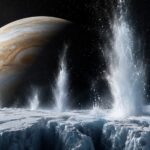









When we picture a volcano, we imagine molten rock, heat, and fire. But in the cold outer reaches of the solar system, far from the Sun’s warmth, a stranger kind of volcano exists. On the frozen moons orbiting Jupiter and Saturn, the lava is water, the rock is ice, and the eruptions blast frozen crystals and vapor into space rather than glowing magma into the sky. This phenomenon, called cryovolcanism, or ice volcanism, has become one of the most exciting frontiers in planetary science, because these icy eruptions may be our clearest window into hidden oceans that could harbor life.
What cryovolcanism actually is
Cryovolcanism is, at its core, the same process as ordinary volcanism but run at a brutally low temperature. On Earth, heat from the planet’s interior melts rock, and that molten material rises and erupts. On an icy moon, the same logic applies, except the warm, mobile material is liquid water, sometimes mixed with ammonia or salts, and the surrounding crust is solid ice rather than stone. When this subsurface liquid finds a path upward, it can erupt through cracks in the ice, freezing almost instantly in the vacuum of space and producing plumes, geysers, and icy deposits on the surface.
The crucial question is what keeps the water liquid so far from the Sun, where surface temperatures plunge to hundreds of degrees below zero. The answer is tidal heating. As these moons orbit their giant planets on slightly stretched, elliptical paths, the immense gravity of Jupiter or Saturn squeezes and relaxes them with every loop. This constant flexing generates friction deep inside, and that friction produces heat, enough heat to maintain vast oceans of liquid water beneath kilometers of frozen crust. Without the Sun, these worlds heat themselves through the gravitational kneading of their parent planets.
The geysers of Enceladus
The most spectacular and best-studied example orbits Saturn. Enceladus, a small, brilliantly white moon, hides a global salty ocean beneath its icy shell, and near its south pole it vents that ocean directly into space. Through a set of fractures nicknamed the tiger stripes, Enceladus shoots towering plumes of water vapor and ice grains hundreds of kilometers high. These jets are so prolific that they continuously resupply one of Saturn’s faint rings with fresh material.
What makes Enceladus extraordinary is not just the spectacle but what the plumes contain. The Cassini spacecraft, which spent years studying the Saturn system, flew directly through these jets and analyzed them. It found salts, molecular hydrogen, and a rich variety of organic compounds. The presence of hydrogen and certain organics points to ongoing chemical reactions on the ocean floor, in conditions strikingly similar to the hydrothermal vents on Earth’s seabed, where life thrives without any sunlight. In effect, Enceladus is squirting samples of its potentially habitable ocean into space, where a passing spacecraft can taste them without ever landing. More recent analysis has continued to find fresh, complex organic molecules in this ejected material, deepening the intrigue.
The uncertain plumes of Europa
Jupiter’s moon Europa presents a similar tantalizing case, though a more ambiguous one. Europa is widely considered one of the most promising places to search for life beyond Earth. Beneath an ice shell estimated at several to a few tens of kilometers thick lies a global ocean believed to hold more than twice as much liquid water as all of Earth’s oceans combined. The ingredients and energy for life may all be present.
The evidence for active eruptions on Europa, however, is less certain than on Enceladus. Telescopes including Hubble have caught tentative signs of water vapor plumes rising from the surface, and these detections line up suggestively with thermal anomalies, warm spots that could mark where subsurface water rises close to the surface. But the activity, if real, appears sporadic or regionally limited rather than the steady fountain seen at Enceladus. Adding to the interest, observations from the James Webb Space Telescope detected carbon dioxide in a geologically young region of Europa’s surface, with evidence suggesting it originated in the ocean below rather than arriving from elsewhere. The picture that emerges is of a moon that may erupt occasionally, hinting at a connection between its hidden sea and its surface.
Beyond geysers, the slow ice volcanoes
Not all cryovolcanism is a dramatic geyser. On some worlds it takes a slower, more sculptural form, building features on the landscape much as molten rock builds volcanoes and lava flows on Earth. Saturn’s largest moon, Titan, with its thick atmosphere and surface lakes of liquid methane, shows landforms that many scientists interpret as cryovolcanic in origin, places where icy slush may have oozed up and resurfaced the terrain. Farther out, Neptune’s moon Triton was seen erupting plumes during a spacecraft flyby decades ago, and hints of past cryovolcanic activity have even been spotted on some moons of Uranus. This slower, dome-and-flow style of ice volcanism reshapes surfaces over long stretches of time, erasing craters and leaving fresh, smooth terrain that betrays a still-active or recently active interior.
Why these icy eruptions matter so much
The reason planetary scientists are so captivated by cryovolcanism comes down to a single word: habitability. For most of history, the search for life beyond Earth focused on Mars and on the warm zone around the Sun where liquid water could exist on a surface. Ocean worlds upend that thinking. They show that liquid water, and possibly the conditions for life, can exist far from any star, sustained by tidal heat in the dark. And cryovolcanism offers something almost too convenient: a way to study these buried oceans without the immense difficulty of drilling through kilometers of ice. The moon does the work for us, lofting its ocean into space where instruments can sample it directly.
This is precisely why the chemistry found at Enceladus caused such excitement. Salts and organics and hydrothermal signatures are exactly the sort of ingredients that, on Earth, support thriving ecosystems in the lightless deep.
The missions closing in
This is no longer a story of distant observation alone. Two ambitious missions are now on their way to the Jupiter system to study its icy moons up close. NASA’s Europa Clipper, the largest spacecraft the agency has ever built for a planetary mission, is cruising toward Jupiter and will make dozens of close flybys of Europa, diving low over its surface with instruments designed to analyze the ice, probe the ocean’s depth, and even sample any plume material it can fly through. Its dust analyzer is built to detect the chemical fingerprints of the ocean in ejected ice grains, and researchers have shown that such an instrument could in principle identify the traces of a single cell.
Traveling in parallel is the European Space Agency’s Jupiter Icy Moons Explorer, which will study Europa, Callisto, and especially Ganymede, the largest moon in the solar system and itself a suspected ocean world. Both spacecraft are using the gravity of the inner planets to slingshot outward, and both are expected to reach Jupiter around the start of the next decade, where they will work as a complementary pair.
When they arrive, they will turn what we now glimpse from afar into detailed, repeated, close-up investigation. The ice volcanoes of these frozen moons, once a curiosity, have become a destination. They are the visible breath of hidden oceans, and in studying them we are asking the oldest question of all, framed in an entirely new place: whether, in the cold and the dark, far from the Sun, something might be alive.